
Back-to-school giving with dignity
What to Put in a Youth Empowerment Back-to-School Care Package
Youth empowerment back to school care package ideas should help a young person feel prepared, welcomed, and seen. The best package supports school readiness without turning a student’s needs into a public story.
Start with readiness, not just supplies
Youth empowerment back to school care package ideas often begin with the obvious items: notebooks, pencils, folders, a backpack, and maybe a calculator. Those items matter because they remove practical barriers. However, a care package becomes more powerful when it is designed around the whole student, not only the classroom checklist.
A strong package answers a quieter question: what helps a young person walk into school with confidence? Youth.gov describes positive youth development as an approach that recognizes strengths, builds supportive environments, and creates opportunities for young people to grow. Therefore, a back-to-school package should send the message that the student is capable, welcome, and worth planning for.
For Believe in Me, that lens connects to youth empowerment across Basic Human Needs, Love and Belonging, Community Support, Education, and Enrichment. A package can reflect all five. It can include the basics a student needs, the small signals of belonging that reduce embarrassment, and the enrichment tools that make school feel like a doorway into something larger.
Pack the basic human needs first
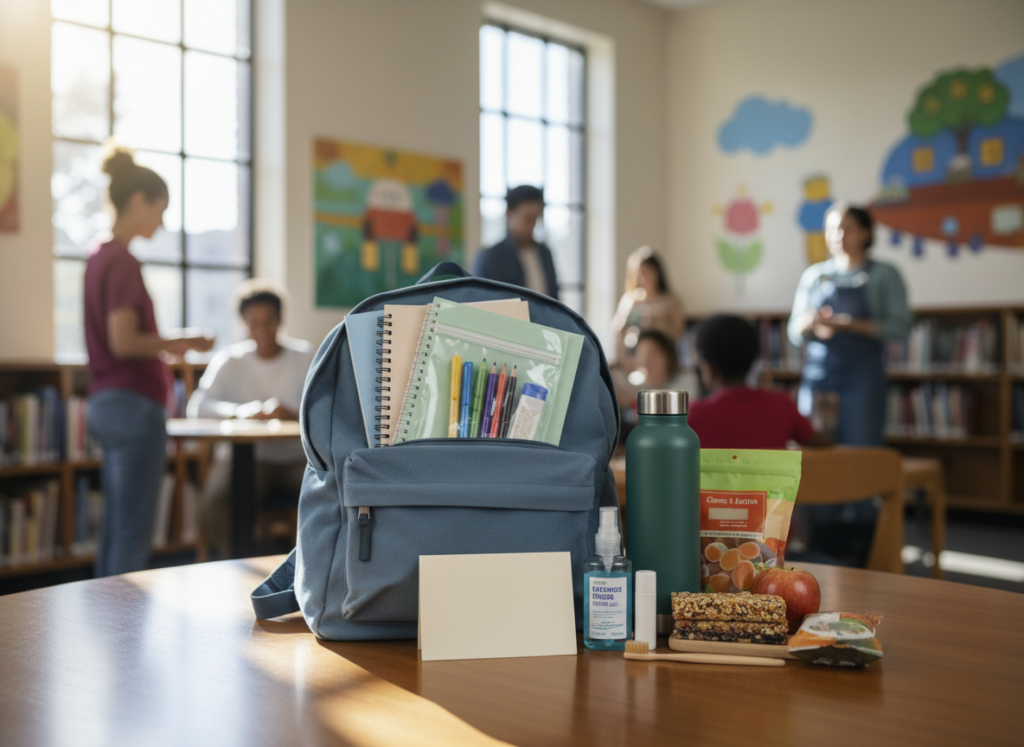
Start with items that protect dignity during the school day. Think hygiene supplies, socks, period products when appropriate, deodorant, tissues, lip balm, a reusable water bottle, healthy snacks, and a discreet pouch for personal items. These choices may sound ordinary. Still, ordinary items can prevent a student from missing class, avoiding peers, or feeling anxious about being noticed for the wrong reason.
Next, add supplies that reduce friction. A durable backpack, notebooks, pens, pencils, folders, earbuds for school devices, a small charger, and a simple planner can help students participate without scrambling. If a donor wants to personalize the package, choose colors or styles that feel age-appropriate rather than childish. Teens especially need support that respects their growing independence.
Also, avoid packing anything that assumes a student’s exact story. Not every marginalized youth needs the same thing, and not every need should be visible. If you are donating through a nonprofit partner, flexible gift cards or program funds may be more respectful than a one-size-fits-all package.
For younger students, ask partners whether comfort items, age-appropriate books, or simple art materials are useful. For older students, consider planners, folders for forms, job-interview basics, or items that support after-school activities. The goal is not to predict every need. The goal is to give trusted adults enough useful options to respond quickly and respectfully.
Add belonging without making it sentimental
A care package can include belonging without turning into a motivational poster. A blank journal, art supplies, a stress ball, a bookmark, a school lanyard, or a simple note card can help a young person feel that someone prepared for them with care. However, keep the tone grounded. Teens can spot performative encouragement quickly.
Belonging also means giving choices. If possible, let students choose a backpack color, notebook style, or enrichment item. Choice is not a small detail. It tells young people that support does not require them to surrender preference, personality, or pride.
The Believe in Me youth empowerment framework centers self-confidence and opportunity for marginalized kids. Because confidence grows through repeated signals of safety and respect, donors should think of each item as part of a larger relationship. The object is useful; the message behind it matters too.
Include education tools that support follow-through
Education support can be simple. Add a folder labeled for important papers, a calendar, sticky notes, index cards, or a weekly planning sheet. For older students, include a college and career question card: What class are you curious about? What club might you try? What adult can help if you get stuck? These small prompts can turn a package into a conversation starter.
If the student has technology needs, coordinate with the school or nonprofit before buying devices. A charger, headphones, or protective case may help, but device requirements vary. Also, some students need transportation, internet access, or a quiet place to work more than another supply item. That is why unrestricted back-to-school gifts to trusted partners can be especially useful.
Finally, include enrichment. A book connected to a student’s interest, a sports bottle, sketchbook, music notebook, museum pass, or activity scholarship can remind youth that school is not only about assignments. It is also about identity, discovery, and the chance to try.
If donors want to support academic confidence, they can also fund tutoring hours, learning subscriptions approved by the partner, calculator access, or quiet study spaces. Those supports may not fit inside a backpack, but they often matter more than another pack of pencils. A strong care package plan leaves room for both physical items and flexible program support.
Make the package easy for partners to distribute
Good intentions can create extra work if donations arrive unsorted, overbranded, or mismatched. Before collecting items, ask the partner organization what ages they serve, what items are most useful, what should be avoided, and whether there are privacy or storage constraints. Then follow the list closely.
Label packages by age range rather than by a student’s personal need. For example, “middle school backpack,” “high school hygiene kit,” or “college and career folder” is more respectful than labels that describe hardship. Also, leave room for staff to customize packages based on what they know about each student.
If a business, church, club, or family wants to help, build a narrow drive with high-quality items rather than a wide drive full of extras. Ten useful kits are better than 50 bags that staff must sort, repair, or supplement before students can use them.
Finally, think about timing. A student may need one package before school starts and another small refresh after the first month, when missing needs become clearer. Planning for a second touchpoint helps partners respond to real life instead of guessing everything in August.
Turn one package into sustained support
Youth empowerment back to school care package ideas are strongest when they become the first step in a longer pattern of support. A package can launch the school year, but students may need help with winter clothing, activity fees, tutoring, transportation, food, or enrichment later. Therefore, donors should pair seasonal giving with recurring support when possible.
This is where Believe in Me’s five-pillar lens helps. Instead of asking, “What can I buy today?” ask, “What conditions help kids keep showing up all year?” That question leads to better giving. It supports practical readiness, emotional belonging, community connection, education, and enrichment at the same time.
A back-to-school package should never ask a young person to be grateful for basics. It should quietly remove barriers and make room for confidence. When donors give that way, the package becomes more than a bag of supplies. It becomes a small, concrete promise that the community is already expecting the student to grow.
Help kids start the school year with confidence
Support Believe in Me’s work so marginalized youth have what they need to feel safe, supported, prepared, and ready to grow.